
Beloit, WI · Garage Door Service
Garage Door Work for Sharon, WI Homeowners
Serving Sharon, WI from Beloit, 15 miles out. We work on the 1960s-70s doors and hardware common to this area's housing stock, not generic big-city setups.
- Repairs & new doors
- Springs & openers
- Serving 4 nearby communities
What We Will Not Take On
We're honest about what we drive out for. Sharon is 15 miles from our Beloit base, so we don't take same-day emergency calls here the way we might closer to the shop - if your spring snaps at 7am and you need the car out by 8, call someone with a truck already in town. We also won't quote a repair sight unseen over the phone for anything involving a bent track or a door that's come off its rollers; those need eyes on the hardware before we say what it'll cost.
We don't install doors we can't get parts for in a reasonable window, and we won't talk you into a full replacement when a cable or roller swap will get you another decade out of the door. If your opener is a dead unit older than the door itself, we'll tell you that too, instead of pretending a new logic board fixes a worn-out gear set.
What we will do is make the drive worth it: diagnose the actual failure, not a guess, and give you a straight answer on whether it's a repair or a replacement job. With roughly 577 households in this area, we're not running a storefront here - we're a crew that comes out from Beloit and does the work right once we're on-site.
This Area's Housing
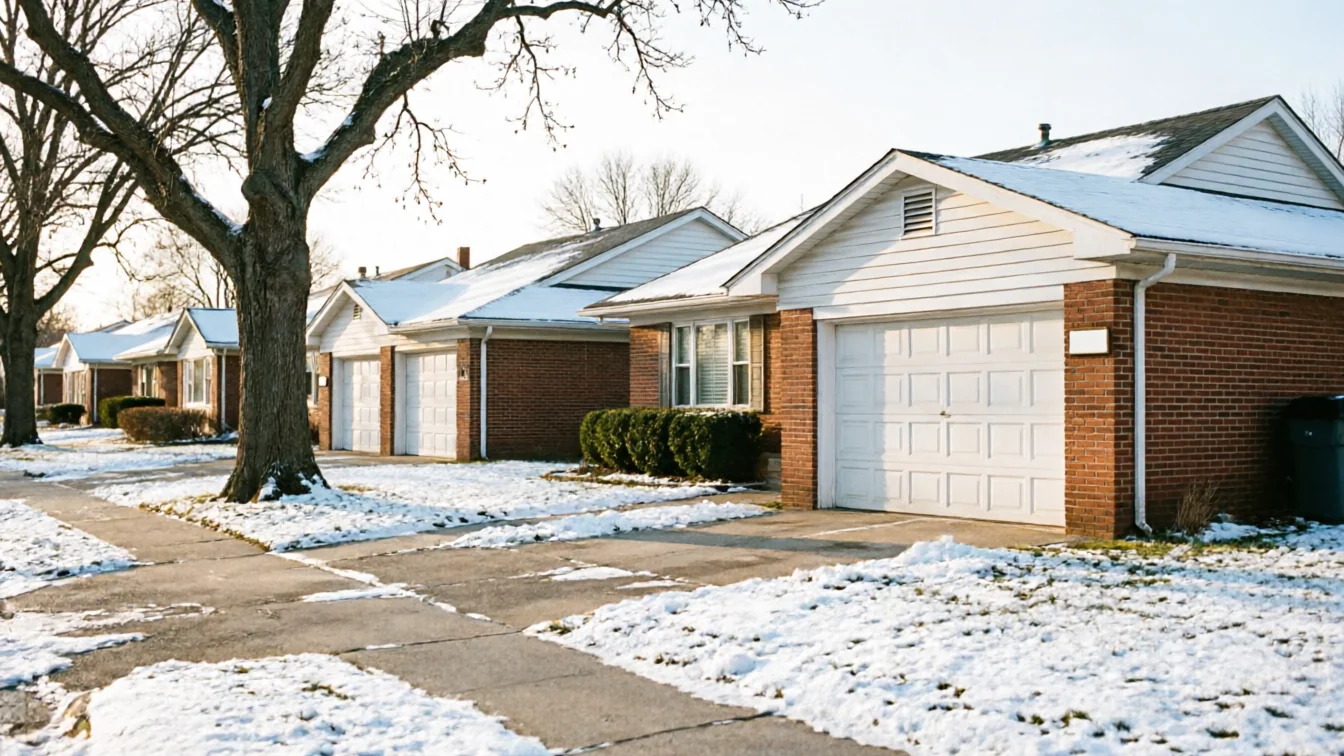
Sharon's housing runs newer than most of what we see across the wider Beloit service area. The median year built here is 1971, a decade past the 1961 median for the broader area covered under F1 - meaning Sharon's homes mostly cleared the first wave of mid-century construction and landed in the later 1960s-and-70s building boom that defined the region.
That decade matters more than it sounds like it should. Garage doors and openers installed on a 1961-built house and a 1971-built house are not the same generation of hardware, even if both count as "old" by today's standard. A house built in 1971 is more likely to have come with an extension-spring door on a short track rather than the heavier torsion setups common on the earlier stock, and more likely to have had an automatic opener added from the factory rather than retrofitted later.
With 577 households in Sharon, this isn't a huge pool of properties, but it's a fairly uniform one age-wise - most of the doors we'd find here are closer in vintage to each other than you'd expect in a bigger, older town. That uniformity is useful: when we know the housing era, we know roughly what we're walking into before we open the truck.
How That Shows Up in the Door
A door from the early 1970s has usually been through at least one spring replacement and maybe one opener swap by now, but the track and drum hardware is often original. On extension-spring systems from that era, the failure point tends to be frayed lift cables or a sagging pulley rather than a broken torsion spring - different symptom, different fix, different parts.
The cold matters here too. This area sits in a severe cold climate band, and on older extension-spring doors the steel stretches and contracts with the temperature swings more than people expect. You'll see it as a door that binds in January and runs loose in July, or as a spring that finally gives out on the first hard freeze because it was already fatigued.
We also see openers from this build era reaching the end of their mechanical life - not electronics, just worn gears and dried-out chain drive - right around now, forty-plus years in. If your opener grinds before it lifts, that's usually gear wear, not a motor problem, and it's a smaller job than people assume.
The Split Between Old and New
Not every house in Sharon dates to 1971 exactly - that's a median, not a rule - so we still run into a mix on any given street. Older homes on the lower end of the area's range can carry heavier torsion hardware closer to what we'd expect from the broader 1961-median housing stock, while newer builds closer to or past 1971 are more likely to have lighter-duty extension systems or early steel sectional doors.
The practical upshot: we don't assume a door type before we see it. A neighbor's door and yours might look similar from the driveway and need completely different parts. What we can say with the income figures we have - median household income here runs $63,250, a bit under the $74,306 median for the wider service area - is that most jobs we see are repair-and-extend work rather than full replacements, since stretching a door's life a few more years tends to make more financial sense than a ground-up swap.
When a repair isn't worth it - rusted track, a cracked wood-composite panel from the original build - we'll say so plainly instead of nursing a door along past the point it's safe.
Frequently asked questions
Do you have a shop or depot in Sharon?
No. We're based in Beloit, about 15 miles away, and drive out to Sharon for scheduled jobs. We don't offer same-day emergency response here the way we might closer to our base, so it's worth calling ahead rather than expecting a same-morning fix.
Why does my door's age matter for the repair?
Sharon's homes run newer than much of the wider service area - median build year 1971 versus 1961 regionally. That decade changes what spring type, track style, and opener generation you likely have, which changes what parts and labor a repair actually needs.
Is it the cold causing my door to stick?
Possibly. This area sits in a severe cold climate band, and older extension-spring doors flex more with temperature swings than people expect - binding in deep cold, running loose in summer. It's a common complaint on doors from the early-1970s building wave.
Should I repair or replace an old opener?
If it's mechanical wear - worn gears, dried chain drive - a repair usually makes sense and costs less than replacement. If the opener predates the door or the motor itself has failed, replacement is often the better call. We'll tell you which one you're looking at once we see it.
Garage door services in Sharon
Every service our crew runs in Sharon, WI.
Book garage door service in Beloit
Call now or request a quote - tell us what the door is doing and where you are.