
Beloit, WI · Garage Door Service
Is Your Beloit Garage Door Worth Fixing, or Done
Beloit's housing mostly dates to 1942-1977, and the cold here is hard on original hardware. Here's how to tell if your door is worth repairing.
- Repairs & new doors
- Springs & openers
- Serving 4 nearby communities
The Problem
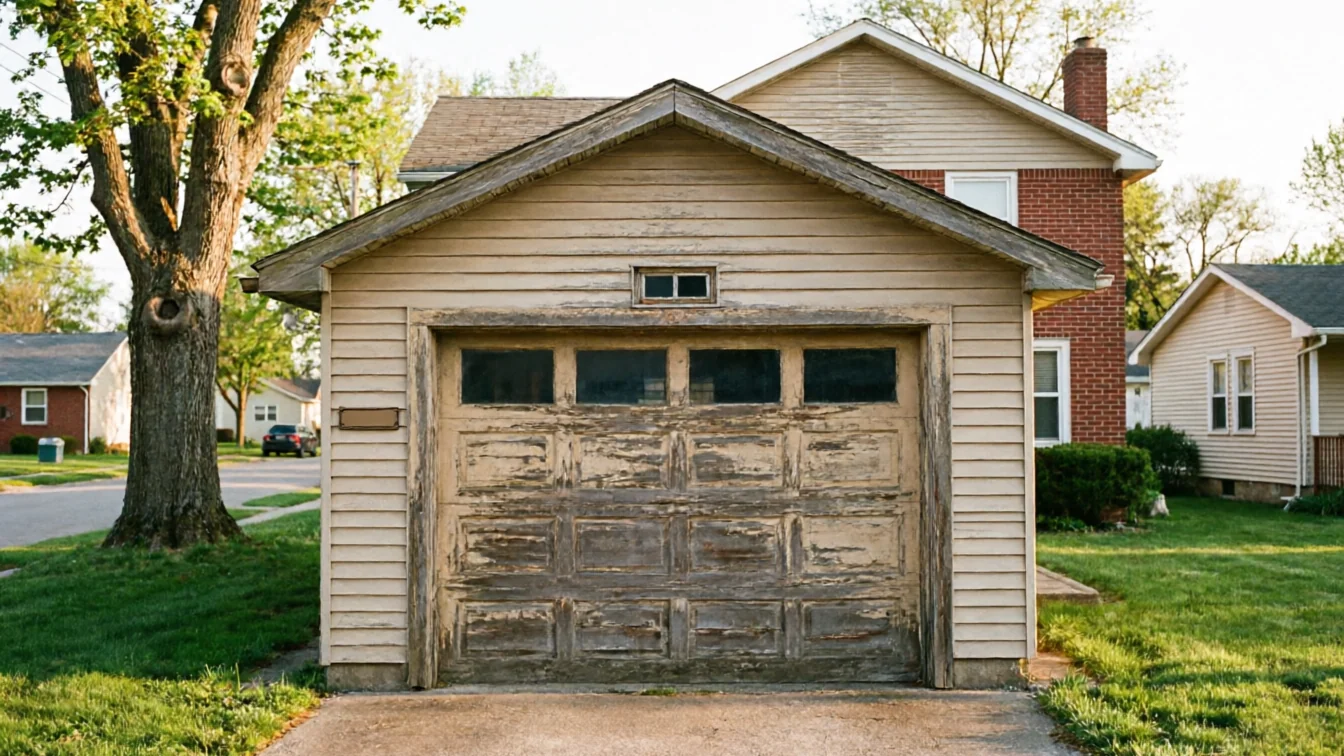
Most of the houses we work on in Beloit went up between 1942 and 1977, with the median build year sitting around 1961. That matters because a door from that era, or a replacement door hung on the original hardware, was built for a different set of expectations than what's on the shelf today. A lot of these garages still have the narrower header clearance and lighter track that came standard on a 1960s build, and when a spring or cable fails on one of these, the fix isn't always a simple swap. Sometimes the track itself has shifted or rusted enough at the mounting points that a new spring just finds the next weak link. We see this across the older neighborhoods in and around Beloit regularly enough that it's not an edge case, it's close to the baseline. The honest answer on whether a door is worth fixing usually comes down to what's underneath the obvious problem: is the track straight, is the jamb solid wood or has it softened, and is the opener bracket still anchored to something real. If those three hold up, repair makes sense. If two of them are gone, you're paying to patch a door that's going to fail again within a year.
What Local Conditions Do
This area sits in a cold-severe climate band, and that changes what breaks and when. Steel contracts in deep cold, which tightens tolerances on tracks and rollers that were already running loose from age. Torsion springs lose a measurable amount of lifting power as temperature drops, so a spring that was marginal in September can snap in January without any new load on it. On doors built to the 1961-era median common in Beloit, the galvanized coating on hardware is often thinner than what's used now, and decades of winter condensation inside an unheated garage will pit that coating faster than people expect. None of this means the door is junk. It means the cold finds the weakest part first, and on a door this old, there's usually more than one weak part competing for that title.
What Changes With the Season
The swing from a mild fall into a hard Beloit winter is when most of these calls come in. A cable that was fraying slowly all summer will usually let go on the first morning below zero, because cold steel is less forgiving of a frayed strand than warm steel. Rollers in track that's slightly out of alignment bind harder when grease thickens in the cold, which puts extra strain on the opener's drive gear. On older one-piece or sectional doors from the 1960s-70s stock common across this area, the wood or hardboard panel bottoms also take on moisture in the fall and then freeze, which can crack a panel that looked fine in July. If a door makes it through a full winter here without a call, that's a reasonable sign the hardware underneath is still sound.
What to Check
Before deciding to replace, look at four things. First, the rollers: if they're the original steel rollers, not nylon, they're original-era hardware and due for wear regardless of how the door sounds. Second, the bottom panel, especially on doors facing north or west where ice sits longer. Third, the track mounting brackets, which rust from the inside out on garages without a vapor barrier, common in homes built before the 1970s. Fourth, the header seal, since a gap there lets cold air hit the spring directly. One limitation worth saying plainly: if the track brackets have pulled loose from the framing, that's a structural repair to the jamb, not a door repair, and it's usually cheaper in the long run to replace the door and track together rather than rebuild around a damaged frame.
Frequently asked questions
My garage door is original to a house built in the 1960s. Is it too old to repair?
Not automatically. A lot of Beloit homes from that era still have solid framing and track, even if the spring or opener has been swapped since. What usually decides it is whether the track brackets are still anchored to sound wood. If they are, repair is often the right call. If the jamb has rotted or pulled loose, replacement makes more sense.
Why does my door seem worse in January than in July?
Cold steel behaves differently than warm steel. Springs lose lifting power as temperature drops, cables that were fraying slowly tend to fail outright in a hard freeze, and grease on rollers thickens, which strains the opener. This area sits in a cold-severe climate band, so that seasonal swing is sharper here than in milder regions.
Does it matter that my house is in an older part of Beloit versus a newer subdivision?
It can. Housing in this service area mostly dates to 1942-1977, with a lot of it concentrated around 1961. Older stock more often has original or early-replacement hardware sized for a different era, which changes what parts are compatible and what the track and header clearance actually allow.
Related garage door services in Beloit
More garage door guides
Book garage door service in Beloit
Call now or request a quote - tell us what the door is doing and where you are.