
Beloit, WI · Garage Door Service
Why So Many Beloit Garages Still Have the Original, Uninsulated Door
In Beloit, most houses date to 1942-1977, median 1961 - years before insulated steel doors were standard. Here's what that means for your garage door.
- Repairs & new doors
- Springs & openers
- Serving 4 nearby communities
The Problem
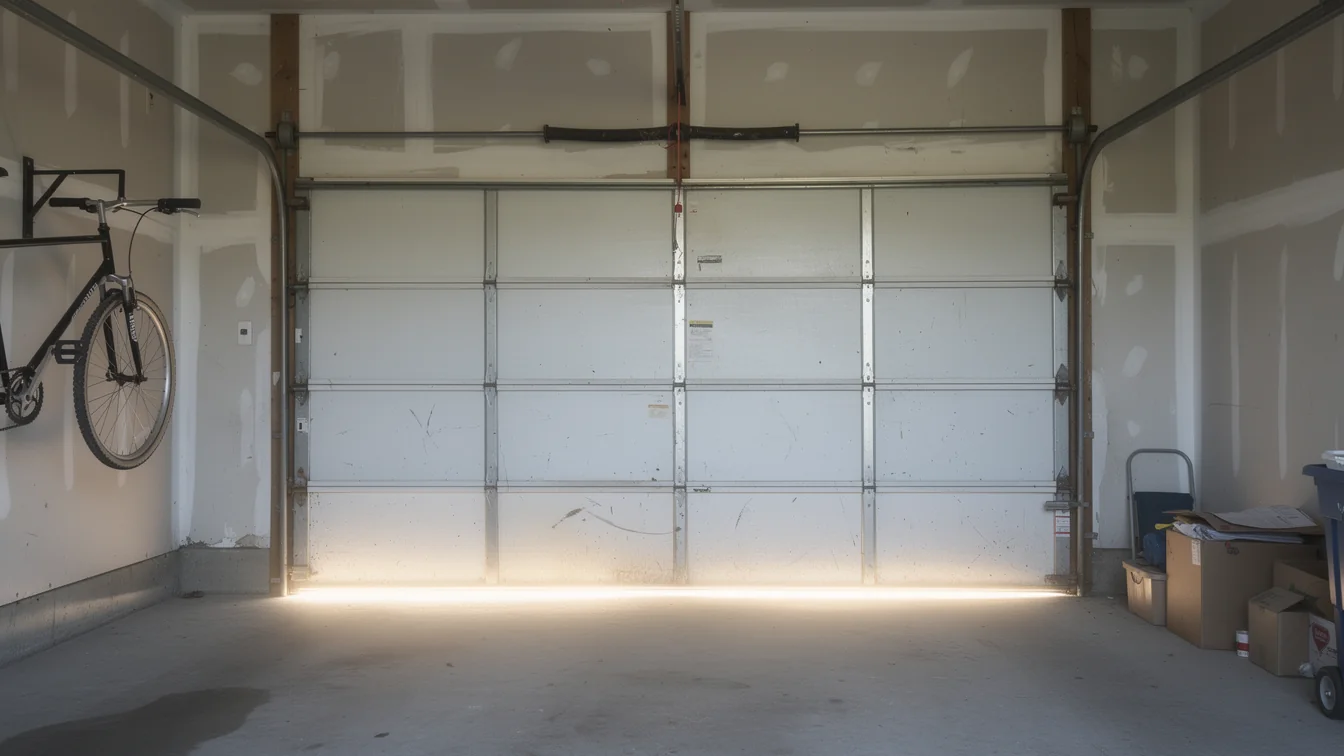
Housing in this service area runs 1942 to 1977, with the median landing at 1961. That's the Eisenhower-to-Nixon stretch, and it means a huge share of garages still carry something close to what came with the house: a single layer of steel, or a wood panel door with no core at all. Nobody was required to put insulation in a garage door back then, so nobody did. It wasn't a corner cut - it just wasn't a rule yet.
That matters more than people think. A door with no insulating layer doesn't just let heat out. It flexes more in temperature swings, which stresses hinges and track alignment over decades. Steel panels from that era are also thinner gauge than what's sold now, so dents and oil-canning show up sooner, and weatherstripping channels that worked fine in 1965 often don't grip the newer rubber seals people try to retrofit onto them.
We see this across the 4,888 owner-occupied houses in this area constantly: a door that still opens and closes fine, but that was never built to hold a thermal break, and is now 60 years into a job it was never designed for.
What Local Conditions Do
This area sits in a cold-severe climate band, and that's the other half of the problem. An uninsulated door built in 1961 wasn't tested against the kind of winter swing this region gets - it was just a barrier, not a thermal envelope. On an attached garage, that single steel or wood layer is often the single biggest heat-loss point in the structure, bigger than any window.
Cold-severe conditions also move moisture around more aggressively than a moderate climate does. Condensation forms on the inside face of an uninsulated steel door when warm garage air meets a cold metal surface, and over sixty-some years that moisture cycle works on the bottom panel, the hardware, and the track mounting points. Wood panel doors from the same era take it worse - swelling, then drying, then swelling again, which eventually loosens the panel joints and throws the door out of square.
None of this is a defect in the original door. It's just what happens when a product built for a 1960s expectation sits through decades of a climate it was never insulated against.
What Changes With the Season
Winter is where the age of these doors shows up fastest. Steel contracts in the cold, and a door with no insulating layer contracts more evenly across its face but less evenly at the seams, where weatherstripping from a later repair doesn't match the original channel depth. That's when you get the gap at the bottom corner that wasn't there in October.
Springs and rollers feel it too. Torsion springs lose a little tension as steel cools, and on a door built in the 1960s that's already carrying extra weight from decades of added hardware, patched panels, or a heavier replacement opener, that seasonal tension drop is more noticeable. Rollers on original track from that era are often steel-on-steel rather than nylon, and cold makes them louder and stiffer before they warm up.
Come spring, the opposite problem shows up: moisture that got into an uninsulated panel over winter starts to show as rust spotting on steel doors or soft spots on wood ones. If a door has made it sixty years, it's usually the freeze-thaw cycle, not one bad winter, that finally tips a marginal panel into a bad one.
What to Check
Start at the bottom panel, since that's where moisture and cold do the most damage on an original-era door. Look for rust bubbling through paint on steel, or soft, swollen wood grain on an older wood door. Either one usually means the panel's structural integrity, not just its looks, is compromised.
Check the weatherstripping at the bottom and sides. If it's cracked, flattened, or pulling away from the track, cold air is getting straight into the garage, and on a door with no insulating core that gap matters more than it would on a newer insulated door.
Push on the panel between the ribs. A little give is normal on an uninsulated steel door. A lot of give, or a section that feels different from the rest of the door, means metal fatigue after decades of flexing.
Here's the honest limit: we don't retrofit insulation into an old panel door. Foam kits exist, but on a door this age the hardware, track, and panel seams are usually past the point where adding weight and a vapor barrier does more good than harm. If the door's structure is sound, a tune-up makes sense. If it's not, replacement is the straighter answer, and we'll tell you which one you're looking at.
Frequently asked questions
Is my garage door original to the house if it was built in the 1960s?
A lot of them are, or close to it. Housing in this area runs 1942 to 1977 with a median year of 1961, and insulated garage doors weren't standard then, so many houses still have either the original panel door or an early replacement from the same uninsulated generation. We can tell you which you've got during an inspection.
Can you add insulation to my old door instead of replacing it?
Usually not in a way that's worth doing. On a door built before insulation was standard, the panel gauge, seams, and hardware weren't designed to carry the added weight of a foam retrofit. If the structure is sound we'll service what's there; if it's not, replacement is the straighter path, and we'll walk you through both before you spend a dollar.
Why does my garage door get louder and stiffer every winter?
Cold contracts steel unevenly at the seams, and in a cold-severe climate band like this one, that shows up fast on a door with no insulating layer. Add decades-old steel rollers rather than nylon ones, and you get the stiff, noisy start-up that loosens up once things warm.
Related garage door services in Beloit
More garage door guides
Book garage door service in Beloit
Call now or request a quote - tell us what the door is doing and where you are.